

Rotary Club of Morro Bay Eco focuses on the environment
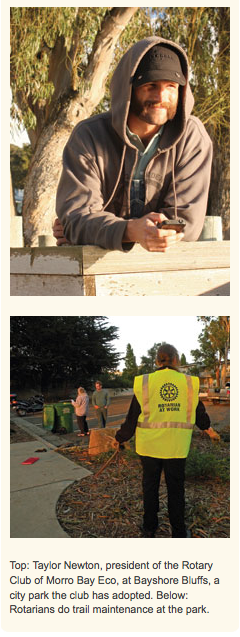 Taylor Newton’s cell phone rings to the tune of “Bad to the Bone.” He attends Rotary club meetings in tattered overalls. He counts former drug addicts and prisoners among his friends. And he calls himself a “guerrilla gardener.”
Newton may be unconventional, but he fits in well at the Rotary Club of Morro Bay Eco, California, USA, which focuses on the environment and the community. “I’m a real believer that you need to teach young people to see the truth about the earth,” says Newton, 35, who is serving as club president this year.
Eco clubs are a new phenomenon in Rotary. Though “eco” is not an official designation, Rotary allows clubs that plan to have an environmental focus to include the word in their name. In 2010, Deepa Willingham, then governor of District 5240, decided to start such a club. She wanted her district to be the first on the West Coast to set up a nontraditional club that was more about action than meetings. “I was looking for a way to make Rotary more attractive to young people – Gen X and Gen Y – who care about the environment and who want to be involved in hands-on projects,” she says.
Willingham turned to John Weiss, a member of the Rotary Club of Morro Bay, for help. He wasn’t sure where to begin, but he did know one thing: He wanted Newton on board. Newton, who studied ecology and systematic biology with a concentration in botany at California Polytechnic State University at San Luis Obispo, had moved to Morro Bay in 2005, at age 27, to establish Newton Cultivation, a grounds management company.
Shortly after he started his business, a group of young men began hanging out at the attached nursery. Newton recruited them to help plant trees in empty tree wells on downtown sidewalks, and the group became known as the Guerrilla Gardening Club. As Newton gained legitimacy – he was invited to join the city’s tree committee and was hired to renovate the landscape of city properties – so did the Guerrillas, who joined him in planting native flowers and grasses on the grounds of the police department, city hall, and community center.
Newton decided to join Rotary in part because of the Guerrillas: He thought it would provide an opportunity for his gardeners to network with successful professionals. The Rotarians, in turn, could tap into the Guerrillas’ manpower to help implement their projects. Together, they have adopted a 3-acre city park, regularly trimming its trees and clearing its paths. During city events, they handle recycling collection. They also helped a local golf course make compost, which it uses instead of traditional fertilizers.
Like Newton, most Morro Bay Eco club members were new to Rotary and were drawn to the club’s environmental emphasis. Trina Dougherty, who works for a local video production company, is a good example. “I probably wouldn’t have joined a club that’s for businesspeople,” she says. “This is more up my alley. I think it appeals to people like me who are not the traditional Rotary type, but who want to do service.”
The Guerrilla Gardening Club, meanwhile, has blossomed into a group that helps young people learn new skills, make friends, connect with mentors, and find work. Newton listens to their ideas, refers them to homeowners who need gardeners, hires them for his own company’s projects, and helps them find jobs in the community. In return, he requires that they spend some of their time volunteering.
About half of the gardening club’s 35 members have had some run-ins with the law. One of them, Mike Leach, credits the club with keeping him on the straight and narrow. “It’s an opportunity to occupy your time so you’re not just sitting and thinking about things and getting in trouble,” he says. “It keeps you busy.”
Dougherty knew several of the Guerrillas before they joined the gardening club. They were good kids, she says, who were headed down the wrong path. Now they talk about their club at city council meetings. “They have started to understand, through Taylor, what it means to be part of the community: that you have to participate in the community, you have to get out there and help and volunteer,” she says. “Then the community looks at you differently.”